

Cell Lock


-
Ref. C301 CELL INTERLOCK, Ref. C301


This interlock type has the same key format as the rest of the HERPE locks, i.e. regular lock (N101 or I101), cabinet lock (N201 or I201), key selector (A402, etc.) or a solenoid commutator (CS701, etc.). Hence they all can be combined in the interlocking sequence.
In electrified premises without power, this interlock type prevents from manipulating any electric device (disconnector, switch, etc.) and leaving it open (doors, fences, etc.) until the manoeuvre is finished, i.e. when access is closed.
An HERPE lock is placed in an access gate (door, fence, etc.), implementing an interlocking sequence that can include a regular HERPE lock (ref.N101) on a switch or disconnector; a switchgear cabinet with an HERPE lock (ref.201); a solenoid commutator (ref.CS701) or a key selector (ref.A402), with the same key code as in the previous examples given. When the movable part of the access gate (door, fence, etc.) is open, the key stays trapped in the lock (ref.C301) and cannot be released until the gate is completely closed.
Características
Door open: Key trapped - Key can't be removed | Door closed: Key released - Key can be removed
-
Ref. C312d RIGHT CELL MINI INTERLOCK, Ref. C312d

This interlocking system is completely combinable with any item in our catalogue – it can be added to an interlocking sequence with other lock types.
In electrified premises without power, this interlock type prevents from manipulating any electric device (disconnector, switch, etc.) and leaving it open (doors, fences, etc.) until the manoeuvre is finished, i.e. when access is closed.
This lock is designed for an easy surface mounting on left hinged doors.
An HERPE lock is placed in an access gate (door, fence, etc.), implementing an interlocking sequence that can include a regular HERPE lock (ref.N101) on a switch or disconnector; a switchgear cabinet with an HERPE lock (ref.201); a solenoid commutator (ref.CS701) or a key selector (ref.A402), with the same key code as in the previous examples given. When the movable part of the access gate (door, fence, etc.) is open, the key stays trapped in the lock (ref.C301) and cannot be released until the gate is completely closed.
Características
Door open: Key trapped - Key can't be removed | Door closed: Key released - Key can be removed
-
Ref. C312i LEFT CELL MINI INTERLOCK, Ref. C312i

This interlock system is completely combinable with any item in our catalogue – it can be added to an interlock sequence with other lock types.
In electrified premises without power, this interlock type prevents from manipulating any electric device (disconnector, switch, etc.) and leaving it open (doors, fences, etc.) until the manoeuvre is finished, i.e. when access is closed.
This lock is designed for an easy surface mounting on right hinged doors.
An HERPE lock is placed in an access gate (door, fence, etc.), implementing an interlocking sequence that can include a regular HERPE lock (ref.N101) on a switch or disconnector; a switchgear cabinet with an HERPE lock (ref.201); a solenoid commutator (ref.CS701) or a key selector (ref.A402), with the same key code as in the previous examples given. When the movable part of the access gate (door, fence, etc.) is open, the key stays trapped in the lock (ref.C301) and cannot be released until the gate is completely closed.
Características
Door open: Key trapped - Key can't be removed | Door closed: Key released - Key can be removed
-
Ref. C320 DUAL KEYBOLT CELL INTERLOCK, Ref. C320
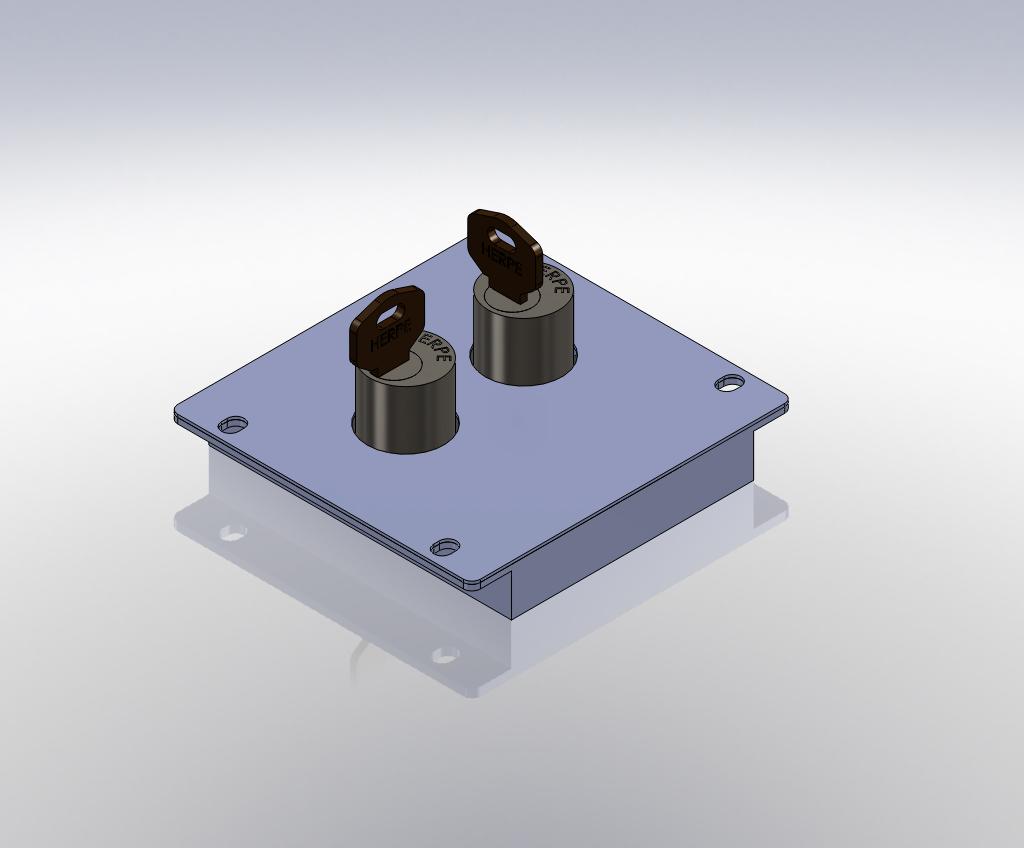
When the door/access (to a cell, for instance) is closed, the upper key stays trapped while the lower cylinder is empty. As the lower key is inserted and turned, the door/access can be opened. As long as it is open, this key will stay trapped. In order to continue with the interlocking sequence, the upper key needs to be released. The lower key won’t be able to turn and lock the door until the upper one is inserted and trapped.
Características
Door closed: Lower key free, upper key trapped | Door open: Lower key trapped, upper key released
-
Ref. C330 TRIPLE KEYBOLT INTERLOCK, Ref. C330

When the door/access (to a cell, for instance) is closed, the upper keys stay trapped while the lower cylinder is empty. As the lower key is inserted and turned, the door/access can be opened. As long as it is open, this key will stay trapped. In order to continue with the interlocking sequence, the upper keys need to be released. The lower key won’t be able to turn and lock the door until the upper ones are inserted and trapped.
Características
Closed door - lower key free: Two upper keys trapped | Open door - lower key trapped: Two upper keys released
-
Ref. CP301 CELL INTERLOCKING SYSTEM, Ref. CP301

This system, coupled with a regular lock (Ref.N101), works exactly as a cell lock (ref.C301). If an HERPE interlock (N-101) is already mounted, there is no need to replace it — the interlocking system (CP301) can simply be coupled.
In electrified premises without power, this interlock type prevents from manipulating any electric device (disconnector, switch, etc.) and leaving it open (doors, fences, etc.) until the manoeuvre is finished, i.e. when access is closed.An HERPE lock is placed in an access gate (door, fence, etc.), implementing an interlocking sequence that can include a regular HERPE lock (ref.N101) on a switch or disconnector; a switchgear cabinet with an HERPE lock (ref.201); a solenoid commutator (ref.CS701) or a key selector (ref.A402), with the same key code as in the previous examples given. When the movable part of the access gate (door, fence, etc.) is open, the key stays trapped in the lock (ref.CP301) and cannot be released until the gate is completely closed.
Características
Door open: Key trapped - Key can't be removed | Door closed: Key released - Key can be removed